When Your Pipeline Becomes the Platform
When Your Pipeline Becomes the Platform
Introduction
A well-designed automation pipeline is far more than just CI/CD — it’s the backbone of modern infrastructure delivery.
From an automation perspective, it is fascinating how we can integrate a wide range of tools, technologies, languages, and processes into a unified workflow capable of achieving complex goals. The ability to chain identity federation, infrastructure provisioning, scripting, and multi-repository orchestration into a single coherent flow is what separates a pipeline from a platform.
Modern delivery systems are increasingly expected to orchestrate full lifecycle operations: executing tests, provisioning storage, creating environments, and coordinating deployments across multiple repositories. In mature setups, the pipeline is no longer just a build runner — it becomes a distributed control layer that governs how infrastructure is created, configured, and maintained.
This shift is precisely what motivated the work described here.
Project Context
In a recent initiative, I designed and implemented an automation framework centered on GitLab CI that integrates:
- Workload Identity Federation (OIDC) — for secretless, token-based cloud authentication
- Terraform — as the Infrastructure as Code backbone
- Reusable multi-repository pipeline components — shared CI/CD logic across projects
- Custom automation scripts (Bash, Python, or any preferred language) — for programmable orchestration logic
The primary objective was to enable secure, scalable, and reusable infrastructure orchestration, moving away from isolated pipeline jobs toward a platform-oriented approach.
⚠️ Note: This project is actively under development. The architecture described here represents the current state, but we are continuously iterating — adding new automation jobs, improving existing ones, and expanding coverage. This article will be updated as the platform evolves.
Architecture Overview
The following diagram represents the conceptual architecture and flow of the system:
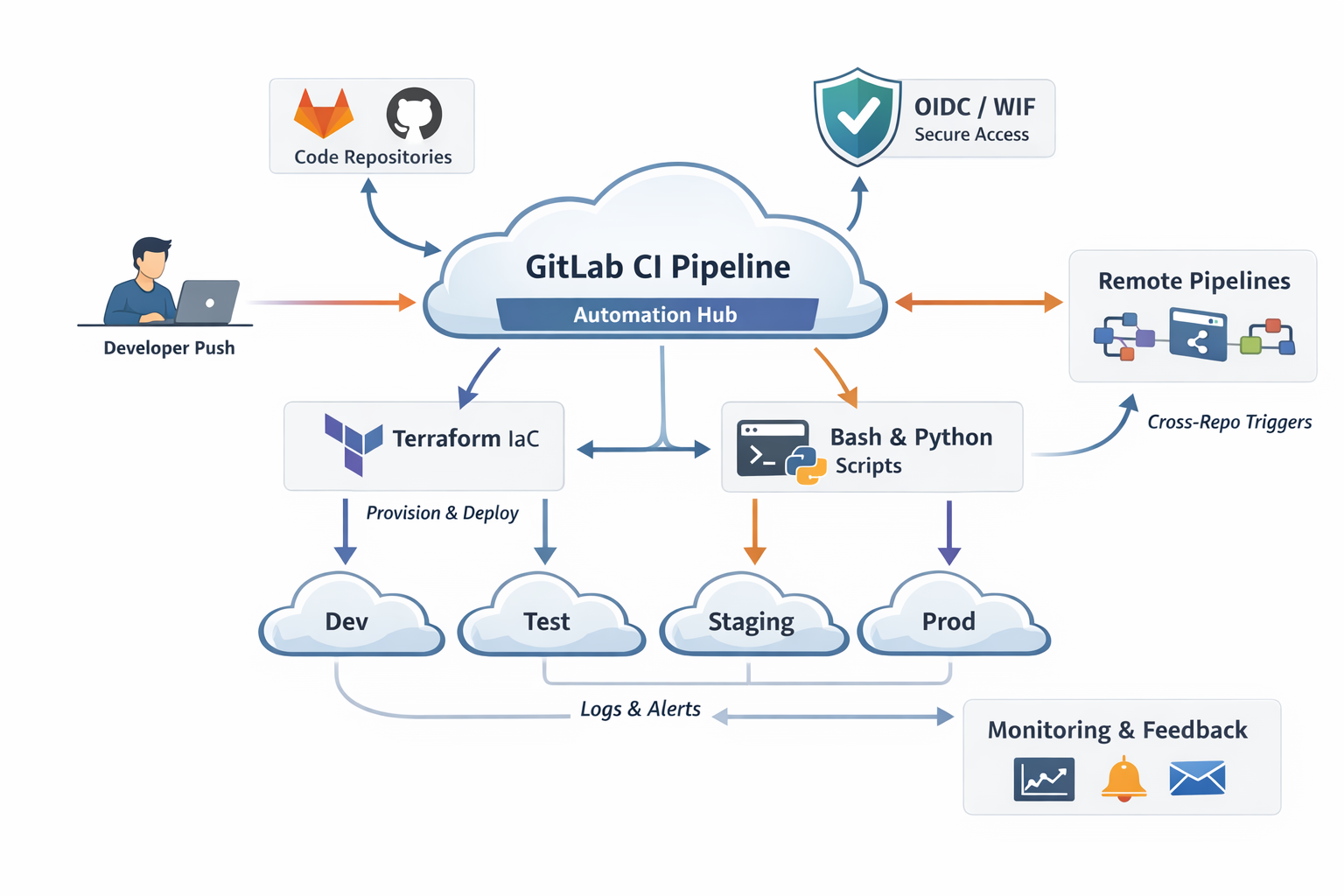
At a high level, the system operates as follows:
- A developer pushes code to a GitLab repository
- The GitLab CI pipeline acts as the central Automation Hub
- The pipeline requests an OIDC token from GitLab
- Workload Identity Federation exchanges the token for temporary cloud credentials — no static secrets involved
- Terraform provisions or updates infrastructure across target environments (Dev, Test, Staging, Prod)
- Custom Bash & Python scripts orchestrate additional logic, validations, and workflows
- The pipeline triggers downstream pipelines across multiple repositories via cross-repo triggers
- Target environments are bootstrapped automatically with all required resources
- Monitoring & Feedback loops provide visibility through logs, alerts, and notifications
This model enables strong security guarantees while maintaining a high degree of automation and flexibility.
Key Design Principles
🔐 Secretless Authentication
By leveraging OIDC and Workload Identity Federation, the pipeline avoids static credentials entirely. Trust is dynamically established at runtime based on the pipeline’s identity.
How it works:
- GitLab issues a short-lived OIDC token for each pipeline execution
- The cloud provider validates the token against a pre-configured trust policy
- Temporary credentials are issued with scoped permissions
- Credentials expire automatically — no rotation needed
Impact:
- Eliminated credential leakage risk
- Simplified credential lifecycle management
- Improved auditability and traceability
- Compliance-friendly by design
♻️ Reusable Pipeline Components
Instead of duplicating CI/CD logic across repositories, pipelines are designed as reusable building blocks hosted in a central repository. Any project — regardless of team or domain — can adopt the full automation pipeline with a single include directive pointing to the central repo.
How it works:
- The complete pipeline logic lives in a dedicated central repository
- Any remote project can consume it by adding a simple
include: remotein their.gitlab-ci.yml - In many cases, only minimal YAML configuration is needed — a few variables to define the project’s context
- The complexity is fully abstracted: the user doesn’t need to understand the underlying orchestration
- Updates to the central pipeline propagate automatically to all consumers
Example — what the user sees:
include:
  - project: 'platform/automation-pipeline'
    ref: main
    file: '/templates/full-pipeline.yml'

variables:
  ENV: "dev"
  PROJECT_NAME: "my-service"
That’s it. The entire automation framework — OIDC auth, Terraform provisioning, environment bootstrapping — is available with just a few lines.
Benefits:
- Dead simple adoption — teams don’t build pipelines, they just include one
- Standardization across teams and projects
- Dramatically reduced duplication and maintenance burden
- Faster onboarding — new projects get full pipeline capabilities instantly
- Consistent security and quality practices
- Central updates benefit all consumers immediately
🧠 Automation as a First-Class Capability
Automation is not limited to predefined CI/CD steps. By integrating scripting capabilities (Bash, Python, or any preferred language), pipelines can:
- Execute complex decision logic based on runtime conditions
- Dynamically adapt to context (branch, environment, configuration)
- Orchestrate cross-system workflows spanning multiple tools and APIs
- Perform data transformations, validations, and pre/post-processing
- Interact with external services (APIs, databases, notification systems)
This transforms pipelines from static execution sequences into programmable automation layers that can handle arbitrarily complex workflows.
🏗️ Idempotent Infrastructure with Terraform
Terraform ensures that infrastructure provisioning is consistent, repeatable, and declarative. Every environment is defined as code, and every change is tracked and versioned.
Key practices:
- Strict state management — remote state with locking to prevent conflicts
- Parameterized environments — same modules, different configurations
- Controlled apply workflows — plan → review → apply with approval gates
- Drift detection and correction — automated checks against desired state
- Module reuse — shared Terraform modules for common infrastructure patterns
🚀 Environment Bootstrapping on Demand
One of the most powerful capabilities is the ability to create complete environments directly from the pipeline — no tickets, no waiting, no manual steps.
This includes:
- Cloud resource provisioning (compute, storage, networking)
- Service configuration and initialization
- Identity and access setup (service accounts, roles, permissions)
- Cross-repository orchestration for dependent services
- Configuration injection and secret management
The result: A self-service platform experience where teams can provision fully functional environments (Dev, Test, Staging, Prod) without manual intervention.
From Pipeline to Platform
The real shift is conceptual, not just technical.
Pipelines are no longer just execution units — they become:
| Traditional View | Platform View |
|---|---|
| Build runner | Orchestration engine |
| Deploy tool | Integration layer |
| Job executor | Security boundary |
| CI/CD step | Platform control plane |
This approach reduces the gap between development workflows and infrastructure operations, aligning both under a unified automation model. Developers don’t need to understand the underlying complexity — they push code, and the platform handles the rest.
Current Jobs & Capabilities
The following automation jobs are currently implemented and operational:
| Job | Description | Status |
|---|---|---|
| OIDC Token Exchange | Authenticates pipeline to cloud provider via WIF | ✅ Active |
| Terraform Plan & Apply | Provisions infrastructure across environments | ✅ Active |
| Environment Bootstrap | Creates complete environments on demand | ✅ Active |
| Cross-Repo Trigger | Coordinates pipelines across multiple repositories | ✅ Active |
| Custom Script Execution | Runs Bash/Python automation scripts | ✅ Active |
| Monitoring Integration | Sends logs and alerts to observability stack | ✅ Active |
Roadmap: What’s Coming Next
This platform is under active development. Here’s a look at what we’re working on and planning:
🔜 Short-term Improvements
- Enhanced rollback automation — automated rollback jobs triggered on deployment failures, with state snapshot recovery
- Pipeline analytics dashboard — centralized visibility into pipeline execution times, failure rates, and resource consumption
- Parameterized environment teardown — automated cleanup of ephemeral environments after a configurable TTL
🛣️ Planned Jobs & Features
- Policy-as-Code integration — embedding OPA (Open Policy Agent) or Sentinel policies directly into the pipeline to enforce compliance before deployment
- Secrets rotation automation — automated rotation of service account keys and certificates with zero-downtime transitions
- Database migration orchestration — coordinated schema migrations across environments with validation checkpoints
- Cost estimation job — pre-apply Terraform cost analysis using tools like Infracost, with budget threshold alerts
- Security scanning integration — SAST, DAST, and container image scanning as mandatory pipeline stages
- Ephemeral preview environments — spin up full environments per merge request for review and testing, with automatic teardown on merge
🔭 Long-term Vision
- Event-driven pipeline triggers — reactive architectures where pipelines respond to cloud events (not just Git pushes)
- Multi-cloud orchestration — extending the framework to provision and coordinate across AWS, GCP, and Azure from a single pipeline
- Self-healing infrastructure — automated remediation jobs that detect drift and restore desired state without human intervention
- Platform API layer — exposing pipeline capabilities through an internal API, enabling other tools and systems to trigger automation programmatically
- AI-assisted pipeline optimization — leveraging ML models to predict failures, optimize resource allocation, and suggest pipeline improvements
💡 Each new job and feature will be documented here as it becomes available. The goal is to build a living platform that grows with the team’s needs.
Current Limitations and Considerations
No architecture is without trade-offs. Key challenges we’re actively addressing include:
| Challenge | Description | Mitigation Strategy |
|---|---|---|
| OIDC trust boundaries | Configuring fine-grained trust policies across projects | Least-privilege attribute conditions |
| Terraform state isolation | Preventing state conflicts in multi-team scenarios | Separate state files per environment + locking |
| Cross-project permissions | Managing access across repository boundaries | Scoped tokens + project-level access controls |
| Distributed debugging | Tracing issues across multi-repo pipeline chains | Centralized logging + correlation IDs |
| Failure handling | Managing partial failures in multi-step workflows | Checkpoint-based recovery + idempotent design |
These aspects require careful design as the platform scales, and they inform our roadmap priorities.
Looking Forward
The trajectory is clear: pipelines are evolving into platform primitives.
In the near future, we can expect:
- 🏛️ Deeper integration with policy engines for automated governance
- ⚡ Event-driven and reactive pipeline architectures
- 🔗 Tighter coupling with platform APIs and service meshes
- 🌫️ Increased use of ephemeral environments for testing and review
- 🪪 Standardization of federated identity patterns across CI/CD platforms
- 🤖 AI-augmented operations for predictive scaling and anomaly detection
Organizations that embrace this shift early will gain significant advantages in scalability, security, and operational efficiency.
Closing Thoughts
Moving beyond traditional CI/CD requires rethinking the role of automation pipelines.
When combined with federated identity, Infrastructure as Code, and programmable automation, pipelines become a powerful abstraction layer for building secure, scalable, and reusable platforms.
This work is actively evolving. We’re building in the open, iterating on real-world feedback, and continuously expanding the platform’s capabilities. If you’re interested in following the progress or discussing similar approaches, I’d love to connect.
The direction is clear — and we’re just getting started. 🚀
Last updated: March 2026